Deloitte Spark Hackathon
Overview
The Green Route (Deloitte Spark Hackathon)
1) Background
Most navigation apps optimize for time and traffic, while environmental impact stays invisible or buried in secondary views. The hackathon challenge (with Deloitte, WWF, and AI Sweden) asked teams to make the planet’s “vital signs” visible and actionable through a digital product.
2) Problem
Users can’t compare routes by environmental impact at the decision moment.
Existing “eco” features are too abstract (CO₂ numbers only), creating weak motivation.
People assume eco-friendly choices require major time trade-offs.
3) Goal
Embed an “environmental intelligence layer” into route planning so users can choose routes that balance speed and environmental impact, and take small actions that feel achievable.
4) My Role
UX/UI Designer + user insight lead:
Defined user needs and behavior-change strategy
Designed key flows + interaction model for route choice
Built the high-fidelity interactive prototype (Figma Make)
Translated complex environmental data into glanceable UI
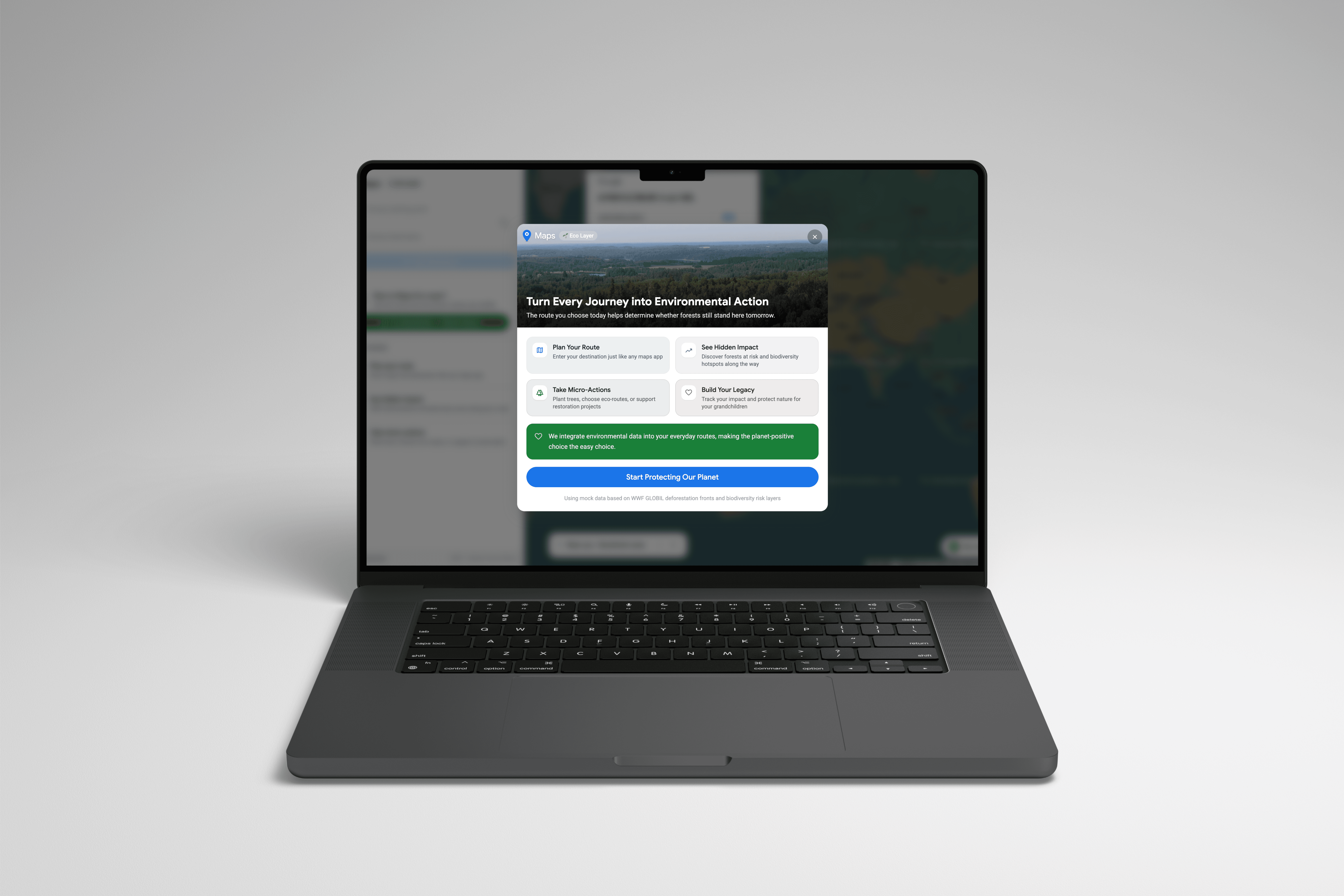
5) Solution (What We Built)
3 route options with clear trade-offs: Fastest / Eco-Balanced (recommended) / Planet Hero
A 0–100% environmental impact score to make comparison simple
Contextual “micro-actions” (e.g., plant a tree for this trip; slow down in wildlife zones)
End-to-end flow: route planning → in-ride guidance → trip summary → personal impact view
6) Outcome
Delivered an interactive hi-fi prototype covering 5 core screens.
Estimated impact: ~120,000 tons CO₂ reduction/year if 5% of users choose the eco-route.
Team won 3rd place at the Deloitte Spark Hackathon.
Categories
UI/UX Design
AI
Date
Deloitte, WWF, AI Sweden


Deloitte Spark Hackathon
Overview
The Green Route (Deloitte Spark Hackathon)
1) Background
Most navigation apps optimize for time and traffic, while environmental impact stays invisible or buried in secondary views. The hackathon challenge (with Deloitte, WWF, and AI Sweden) asked teams to make the planet’s “vital signs” visible and actionable through a digital product.
2) Problem
Users can’t compare routes by environmental impact at the decision moment.
Existing “eco” features are too abstract (CO₂ numbers only), creating weak motivation.
People assume eco-friendly choices require major time trade-offs.
3) Goal
Embed an “environmental intelligence layer” into route planning so users can choose routes that balance speed and environmental impact, and take small actions that feel achievable.
4) My Role
UX/UI Designer + user insight lead:
Defined user needs and behavior-change strategy
Designed key flows + interaction model for route choice
Built the high-fidelity interactive prototype (Figma Make)
Translated complex environmental data into glanceable UI
5) Solution (What We Built)
3 route options with clear trade-offs: Fastest / Eco-Balanced (recommended) / Planet Hero
A 0–100% environmental impact score to make comparison simple
Contextual “micro-actions” (e.g., plant a tree for this trip; slow down in wildlife zones)
End-to-end flow: route planning → in-ride guidance → trip summary → personal impact view
6) Outcome
Delivered an interactive hi-fi prototype covering 5 core screens.
Estimated impact: ~120,000 tons CO₂ reduction/year if 5% of users choose the eco-route.
Team won 3rd place at the Deloitte Spark Hackathon.
Categories
UI/UX Design
AI
Date
Deloitte, WWF, AI Sweden



© 2025 All right reserved
Made by Yunfei
Send a request, and I’ll take care of the rest
© 2025 All right reserved
Made by Yunfei
© 2025 All right reserved
Made by Yunfei